
Hankook Tire Completes Tennessee Plant Expansion, Doubles Production Capacity
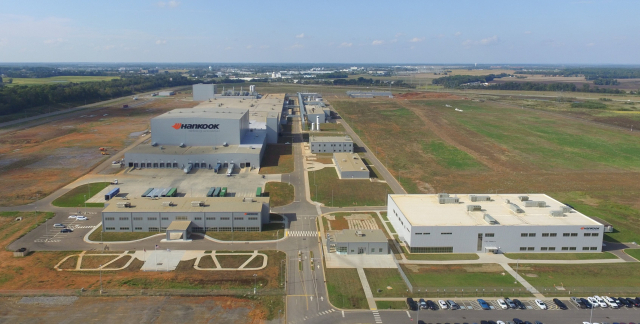
Hankook Tire & Technology (161390.KS) has completed the expansion of its Tennessee plant, a key North American production hub, and is preparing for full-scale mass production. The company plans to gradually increase output and achieve full operational capacity next year, aiming to source approximately half of its North American sales locally.
According to industry sources on the 11th, Hankook Tire is conducting trial production at the expanded Tennessee facility. The company is in the final stages before normal operations, checking for equipment issues and verifying tire quality standards. Following trial production, Hankook plans to produce initial volumes this month and gradually increase output to reach 100% utilization by the end of next year.
The expansion is a core project Hankook has been pursuing to strengthen its North American business. Once the expanded lines are fully operational, annual production capacity for passenger car and light truck (PCLT) tires will double. Considering current capacity of 5.5 million units annually, total capacity will reach 11 million units. The new lines can also produce up to 1 million truck and bus radial (TBR) tires annually, bringing total capacity to 12 million units. This expansion not only increases local production volume but also diversifies the product portfolio.
The North American market is a key region, accounting for 23.3% of Hankook's tire business revenue in the third quarter of this year, or 631 billion won ($464 million) out of 2.707 trillion won. North American tire revenue grew 21.9% from 1.92 trillion won in 2017, when the Tennessee plant was completed, to 2.34 trillion won last year. However, local production accounts for only about 25% of sales. Approximately 75% of North American sales volume is imported from plants in Korea and Indonesia. The company expects this expansion to raise the local production ratio to around 50%, helping minimize tariff burdens amid rising U.S. protectionism. In the third quarter, Hankook partially offset tariff costs through price increases in North America but still incurred 27 billion won in related expenses.
Local sourcing is also expected to reduce logistics costs and shorten lead times from order to delivery. With competitively priced, high-quality products, the company can expand partnerships with major North American automakers and secure new business opportunities such as original equipment tire supply. Hankook is currently in discussions with local companies regarding electric truck and bus tire supply.
Industry observers expect Hankook to leverage this investment to increase production of high-value products such as high-inch and eco-friendly vehicle tires, pursuing both market share expansion and improved profitability in North America. The region shows strong preference for SUVs and hybrid vehicles. The share of 18-inch and larger tires in Hankook's PCLT revenue in North America rose from 52.8% in the third quarter of last year to 55.8% in the third quarter of this year.
Hankook's global production network restructuring is also expected to accelerate. With the Tennessee expansion reducing exports to the U.S., the company plans to redirect supply capacity from Korean and Indonesian plants to target other markets including Southeast Asia, Africa, and the Middle East. The strategy aims to reassign roles across global production bases to enhance efficiency and build a stable revenue foundation.
"Hankook's Tennessee plant expansion appears to be a strategic investment to proactively respond to changing global market demand," an industry official said. "It is expected to accelerate growth in the North American market by enhancing local production competitiveness while also maximizing global supply chain efficiency."