
Korea to Expand Offshore Wind Capacity to 25GW in 10 Years
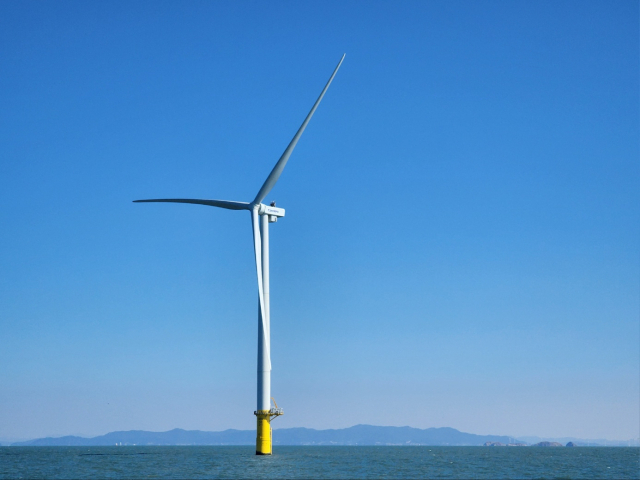
The Korean government plans to dramatically expand cumulative offshore wind farm capacity under construction or completed to 25 gigawatts (GW) within 10 years, up from just 250 megawatts (MW) as of late last year. To achieve this goal, the government will secure dedicated wind power berths nationwide and acquire at least two 15MW-class wind turbine installation vessels (WTIVs) to enable annual installation capacity of 4GW.
The Ministry of Climate, Energy and Environment announced the "Offshore Wind Infrastructure Expansion and Supply Plan" at the second meeting of the cross-government task force for accelerating offshore wind deployment, held at Iroom Center in Yeongdeungpo-gu, Seoul, on Thursday.
The plan's core objective is to establish a stable mid-to-long-term roadmap that enables 25GW of facilities to begin or complete construction over the next decade. "This goes beyond declarative goals to focus on field-level requirements, ensuring offshore wind deployment can begin in earnest after 2030," a ministry official said.
To support this, the ministry will expand infrastructure to achieve annual offshore wind installation capacity of 4GW. Offshore wind turbines are massive structures—the Vestas 15MW model, for example, has a tower height exceeding 125 meters and blade length of 116 meters. Combined, the tower and blades approach the height of Seoul's Namsan Tower (236.7 meters). Dedicated berths and installation vessels are essential to store, transport and install these enormous tower and blade components.
Currently, Korea has only two dedicated offshore wind berths at Mokpo New Port. Given that most offshore wind projects are concentrated along the southwestern coast, the government plans to expand Mokpo New Port's dedicated berths to four and designate the privately developed loading facilities at Haenam Hwawon Industrial Complex as dedicated berths. Additional dedicated berths will be established at Ulsan South New Port, Incheon Port, Gunsan Port, Pohang Yeongil Bay Port and Saemangeum New Port.
The government is also accelerating WTIV acquisition. Korea currently operates two 10MW-class WTIVs, which are insufficient for upcoming large-scale projects of 15MW or above. Hanwha Group is building a 15MW-class WTIV targeting deployment at the Sinan-ui offshore wind project by June 2028. Additionally, Korea Electric Power Corporation (KEPCO) and private partners will jointly invest to secure another 15MW-class WTIV. This would bring annual installation capacity to 2.5GW. The government plans to acquire two more vessels after 2030 to reach total installation capacity of 4GW.
"Both dedicated berths and WTIVs will be secured at the 15MW-plus level," a ministry official said. "This means we can install all generator equipment of 20MW or larger that may be developed in the future."
After securing this supply capacity, the government will release a 10-year bidding roadmap in the first half of next year to reduce generation costs. The strategy targets private sector expansion of turbine and substructure production capacity to drive down costs. Specifically, offshore wind generation costs will be reduced from the current 330 won per kilowatt-hour (kWh) to below 250 won by 2030 and below 150 won by 2035.
The government is also ramping up financial support and streamlining permits. It will consult with related ministries to deploy the planned 150 trillion won National Growth Fund for offshore wind projects. The Future Energy Fund, which has raised 1.26 trillion won in its first phase, is also being considered for offshore wind investment. Guarantee limits per project will increase from 32 billion won to 40 billion won, while loan support limits will double from 80 billion won to 160 billion won.
Safety inspection periods for offshore wind, which previously took nearly six months, will be dramatically reduced to approximately one week. For military operational reviews—cited as the biggest uncertainty in project development—the ministry is conducting a comprehensive survey of ongoing projects and negotiating with military authorities. The ministry also announced it will launch the Offshore Wind Power Promotion Unit within this year, ahead of its originally planned establishment following enactment of the Special Act on Offshore Wind Power.
Measures to strengthen the domestic supply chain ecosystem were also announced. The government will support research and development for domestically developed super-large turbines of 20MW or above. For floating offshore wind—still in early commercialization globally—Korea aims to secure proprietary models through core technology R&D and establish a 100MW-class test bed to capture market leadership.