
Immigrants Now 5% of Korea's Population, Prop Up Aging Economy
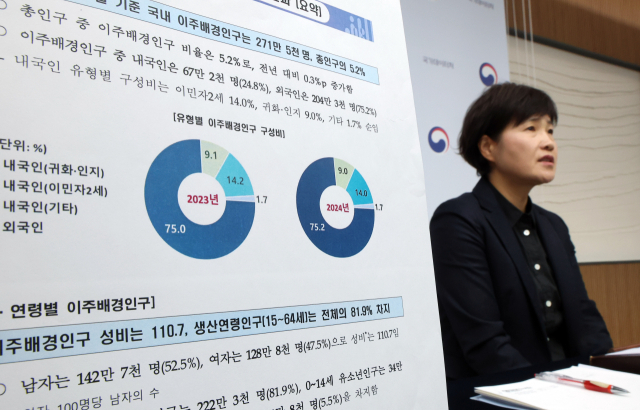
South Korea's immigrant-background population — including foreign residents, naturalized citizens and second-generation immigrants — has exceeded 5% of the total population for the first time, effectively marking the country's transition into a multicultural society. More than 80% of this group are of working age (15-64), positioning them as a critical pillar supporting the economy as Korea grapples with low birth rates and rapid aging.
According to the "2024 Immigrant-Background Population Statistics" released by the National Data Center on Thursday, the number of immigrant-background residents who lived in Korea for three months or longer reached 2.715 million as of November 1 last year. This represents a 5.2% increase (134,000 people) from the previous year and accounts for 5.2% of the country's total population of 51.806 million — far outpacing the overall population growth rate of 0.1%.
The immigrant-background population refers to individuals who, or whose parents, have a migration background, encompassing not only foreigners but also naturalized citizens, recognized children and second-generation immigrants. Academic and international standards typically classify a society as multicultural when this group exceeds 5% of the population. Analysts interpret this as a symbolic indicator that Korea has structurally moved beyond being a single-ethnic nation into a full-fledged immigrant and multicultural society.
By category, foreigners numbered 2.043 million, accounting for 75.2% of the total, while Korean nationals (naturalized citizens, recognized children, second-generation immigrants) numbered 672,000 (24.8%). The growth rate for foreigners (5.6%) outpaced that for nationals (4.1%), driving the overall increase. "Foreign workers, international students and marriage migrants have been increasing, and as they naturalize or marry and have children, they form families, expanding the immigrant-background population," explained Kim Seo-young, Director of the Population Census Division at the National Data Center.
The most notable finding is the age structure of the immigrant-background population. Of the total, 2.223 million (81.9%) are working-age adults between 15 and 64, while those 65 and older account for just 5.5% (148,000). This stands in stark contrast to Korea's overall demographic structure, where those 65 and older exceed 20% of the total population. "While Korea's total population is concentrated in the 50s, 40s and 60s age groups, the immigrant-background population is relatively younger," Kim said.
By age group, those in their 30s were the largest cohort at 660,000 (24.3%), followed by those in their 20s at 570,000 (21.0%). Notably, the population in their 20s surged by 42,000 (8.0%) from the previous year, showing the steepest increase. This demonstrates that the immigrant-background population is serving as a key pipeline for labor supply in Korea's economy, which faces workforce shortages across industrial sites.
The residential distribution is heavily concentrated in the Seoul metropolitan area and near industrial complexes, where jobs are plentiful. A total of 56.8% (1.542 million) reside in Seoul, Gyeonggi Province and Incheon. By province, Gyeonggi had the highest number at 887,000 (32.7%), followed by Seoul (17.5%), Incheon (6.6%), South Chungcheong Province (6.5%) and South Gyeongsang Province (6.2%). At the municipal level, concentrations were highest in manufacturing hubs including Ansan (113,000), Hwaseong (85,000) and Siheung (81,000) in Gyeonggi Province.
The immigrant-background population ratio in regions facing depopulation risk is also noteworthy. Yeongam County in South Jeolla Province had the highest ratio, with 21.1% of residents having an immigrant background, followed by Eumseong County in North Chungcheong Province (19.9%) and Ansan (16.1%). Among 229 municipalities nationwide, 17 had immigrant-background population ratios exceeding 10%. This suggests the immigrant-background population is serving as a bulwark against regional extinction, beyond merely supplementing the labor force.
Significant shifts were also detected in the composition of children and youth, who represent Korea's future. The immigrant-background population aged 24 and under reached 738,000, a 7.9% increase from the previous year, accounting for 27.2% of the total immigrant-background population. By parental nationality, Vietnam topped the list at 27.2%, followed by China (16.5%) and ethnic Koreans from China (12.0%). Unlike the past when ethnic Koreans from China and Chinese nationals dominated, the Vietnamese population arriving through marriage migration and study has settled permanently, leading to a rapid increase in second-generation children. "The influx of Vietnamese nationals has been the recent trend due to increases in international students, workers and marriage migrants," Kim said.