
Navy Landing Ship Fire Caused by Safety Violations, Probe Finds
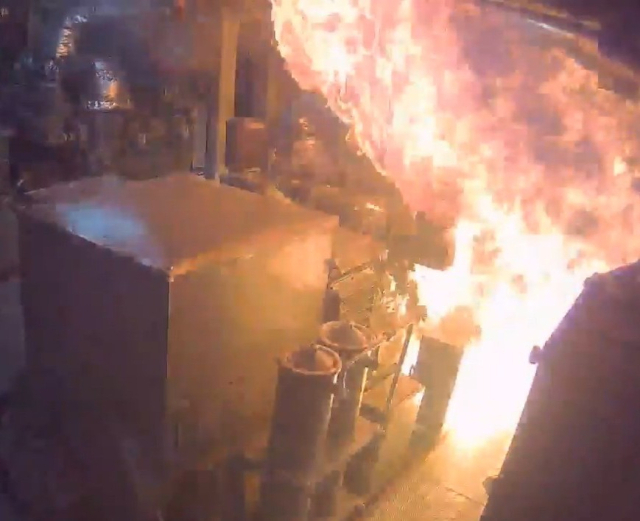
The fire aboard the South Korean Navy landing ship Hyangrobong (2,600 tons) in July was caused by crew members failing to follow safety protocols, an investigation has found.
The Navy announced the results of the fire investigation on Wednesday.
On July 31, a fire broke out in the auxiliary engine room of the Hyangrobong as it was returning to Jinhae Port after supporting training exercises for Reserve Officers' Training Corps (ROTC) cadets. One petty officer suffered burns and dozens of crew members were treated for smoke inhalation.
The Navy formed an accident investigation committee immediately after the incident. The probe confirmed that the fire occurred because auxiliary engine room personnel failed to properly follow safety procedures during fuel transfer operations.
Two days before the accident, two enlisted sailors in the engine department opened a sampling valve connected to the fuel transfer pump in the auxiliary engine room to fill a portable fuel container, but failed to close the valve afterward.
On the day of the accident, a petty officer shut off the outlet valve while completing fuel transfer operations without first stopping the transfer pump, causing excessive pressure to build up in the fuel system. This violated the protocol requiring the pump to be stopped before closing the valve.
As a result, a hose connected to the open sampling valve ruptured, spraying fuel in aerosol form. The sprayed fuel contacted a high-temperature section of an adjacent generator, triggering an explosive fire.
The investigation also found that the crew used a transfer pump instead of a purifier, contrary to guidelines.
"In the case of the Hyangrobong, the equipment (purifier) was aging, so the crew had been using the transfer pump, which requires less work time," explained Rear Admiral Jung Seung-il, chairman of the accident investigation committee.
The Navy said inadequate staffing of non-commissioned officers was also a contributing factor. The ideal crew composition for the Hyangrobong is one master sergeant, one staff sergeant, five sergeants, and five enlisted sailors. At the time of the accident, the actual staffing was one master sergeant, four sergeants first class, one sergeant, and five enlisted sailors.
"When sergeants perform tasks, staff sergeants should be on site working alongside them and providing guidance, but this was lacking because there were no staff sergeants," Jung said.
In the accident, one sergeant conducting the fuel transfer operation suffered third-degree burns to his right arm and other areas and is being treated at the Armed Forces Capital Hospital. Thirty-five others were treated for smoke inhalation and have since recovered.
The Hyangrobong, built in 1997 at a cost of 39.4 billion won, could have served approximately four more years based on its 30-year service life. However, with extensive damage to the bridge, engine control room, and crew quarters, the ship is expected to be decommissioned.
"The cost of repairing the damaged equipment exceeds the value of the ship after restoration," a Navy official said.