
Property Rights vs Public Access: Conflicts Over Pedestrian Paths in Apartment Complexes Spread
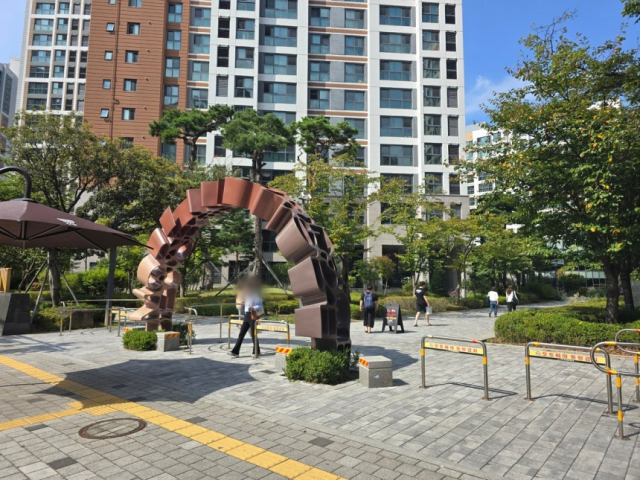
An increasing number of apartment complexes are restricting outside access by installing fences or controlling entry after move-in begins, despite having included public pedestrian path provisions in their redevelopment plans to obtain construction permits. Critics point out that effective measures are needed as local governments have limited options beyond imposing compliance fines and penalties to resolve these conflicts.
According to real estate industry sources on January 5, Godeok Arteon in Sangil-dong, Gangdong-gu, sent a cooperation letter last month to neighboring apartment complexes including Godeok Gracium titled "Notice Regarding Restrictions on Outside Access and Strengthened Regulations at Godeok Arteon."
The letter warned that Godeok Arteon would impose an order maintenance fee (violation fine) of 200,000 won per incident if outsiders ride electric kickboards or electric bicycles on the complex's ground level. The complex also announced it would collect violation fines of 100,000 won for smoking within the complex, failing to clean up pet waste, and entering restricted areas such as children's playgrounds. Additionally, outside visitors without resident accompaniment are restricted from using pathways and facilities within the complex.
Godeok Arteon residents are managing outside access in this manner because the public pedestrian path is private property. A Gangdong-gu Office official explained, "During redevelopment, the union included the public pedestrian path in the development plan but did not receive incentive benefits for it. Conflicts have grown because despite heavy foot traffic, management responsibility falls on the Arteon complex." The official added, "It is difficult for the district office to restrain how residents manage their private property, but we are planning to support the installation of additional CCTV cameras and conduct public pedestrian path order maintenance campaigns to resolve conflicts."
Pedestrian path conflicts are not limited to Sangil-dong. Daechi Honor Hills in Gaepo-dong, Gangnam-gu, had planned an open complex accessible to the public but installed 1.5-meter-high walls requiring access card authentication in 2023, restricting passage after complaints that hikers were passing through the complex. Raemian Blestage and Gaepo Raemian Forest in Gaepo-dong also installed walls at entrances the same year to prevent outsiders from entering.
Public pedestrian paths are typically reflected at the district unit planning stage for pedestrian convenience, but many residents oppose opening complexes to the public due to pet waste issues and safety concerns. When the redevelopment plan for Apgujeong District 3 in Gangnam-gu was approved in October this year, the initial rapid integrated planning agreement with Seoul City had included ground-level public pedestrian paths leading to the Han River. However, after the union changed these to underground passages and roads, the plan was rejected once in August before being approved after reverting to the ground-level design. Still, within the Apgujeong District 3 union, opinions are emerging that 24-hour unrestricted passage should be blocked after completion.
Complexes located near subway stations, like Arteon, show particularly strong resident determination to restrict access due to foot traffic. The Hanshin Muhak complex in Hawangsimni-dong, Seongdong-gu, near Sangwangsimni Station on Line 2, also closed a passage that previously connected to the neighboring Muhak Hyundai complex. A representative from a real estate agency in Doseon-dong explained, "Good station access means convenient commuting and is a factor immediately linked to property values, so there is an atmosphere of wanting to exclusively enjoy the benefits of being near a station."
Public pedestrian path conflicts have spread beyond Seoul to Seongnam, Gwangju in Gyeonggi Province, and Busan, occurring continuously nationwide, but local governments have few measures available beyond imposing fines. A Seoul City official explained, "For complexes completed before 2023, penalty provisions in district unit plans were inadequate, so many cases ended with fines of 1 million won imposed for illegal facility installation." The official added, "For complexes under review since then, we are considering establishing 'easements' on public pedestrian paths and designating them as special building zones to impose compliance fines until corrections are made."
An easement refers to the right to use another person's land for purposes such as passage. If an easement is established on a public pedestrian path, the easement is recorded in the registry. If access by outsiders is blocked, the city can file civil litigation.
There have also been court rulings that it is difficult to prevent fence installation if the public pedestrian path is private property. In August last year, the Seoul Administrative Court ruled in favor of the plaintiff in a lawsuit filed by the residents' representative council of Gyeonghuigung Xi Complex 2 in Jongno-gu against the Jongno-gu district chief regarding the rejection of fence installation.