
Wagner's 'Tristan und Isolde' Makes Historic Korean Premiere to Standing Ovations
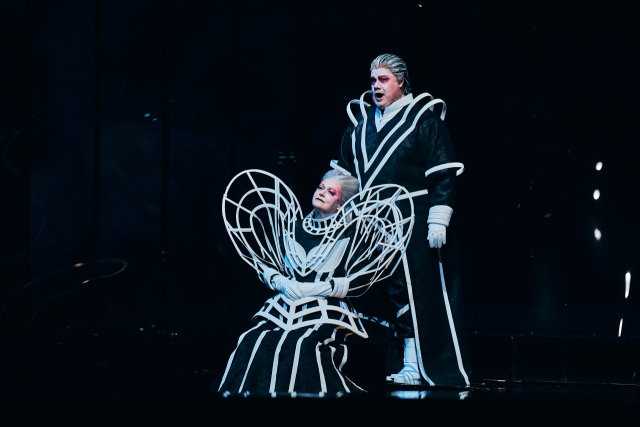
Richard Wagner's operatic masterpiece "Tristan und Isolde" has drawn significant attention as it was fully staged in Korea for the first time, 160 years after its world premiere. Four performances were held at the Seoul Arts Center Opera House from January 4-7, and despite a running time exceeding five hours, the venue was filled with Wagnerians and classical music fans throughout the run. Audience response was enthusiastic even though attending required dedicating an entire day to the experience.
The production, jointly created by the Korea National Opera and the Seoul Philharmonic Orchestra, is being hailed as a milestone in Korean opera production history. The significance lies in staging "Tristan und Isolde"—the pinnacle of Romanticism and a turning point in music history that upended conventional tonal systems—as a Korean production. While the lead roles and stage direction were entrusted to international masters, much of the production including supporting roles, chorus, and orchestra was filled by Korean talent.
Among the principal cast, the double-cast Isoldes particularly won audience acclaim with their distinct charms. Catherine Foster, performing on January 4 and 6, delivered a polished stage presence with seasoned phrasing and stable vocalization. Elisabete Matos, who took the stage on January 5 and 7, left a strong impression with her overwhelming vocal power that cut through the orchestra. Stuart Skelton as Tristan (January 4 and 6) offered solid interpretation but appeared limited in stage movement due to his physique, while Bryan Register (January 5 and 7) had an attractive timbre but left something to be desired in vocal projection.
Korean singers distinguished themselves in the production. Bass Park Jong-min, who played King Marke, particularly stood out as he conveyed the anguish of betrayal by a trusted knight intertwined with heartbreak through his majestic low register, filling every corner of the hall.
The direction, staging, and costumes drew mixed reactions. The ship traveling between Cornwall and Ireland in the original was transformed into a spacecraft, and the sea became the vast expanse of space. This was an attempt to reinterpret Wagner's pessimistic worldview of "love fulfilled through death"—which negates life and yearns for death—into the more positive meaning of "eternal love completed through infinity." The attempt to give a modern interpretation to a 160-year-old work has merit. The symbolic imagery of meteor showers and Star Trek-esque costumes received mixed reactions—some found them refreshing while others felt they undermined emotional engagement.
The decision to use only a single mirror structure instead of the originally proposed three stage sets also drew criticism. At certain angles, this mirror reflected the conductor in the orchestra pit directly to the audience, creating moments that disrupted immersion.
The Seoul Philharmonic Orchestra was another protagonist of this production. Despite not being an orchestra specialized in opera accompaniment, they delivered this demanding complete work with high quality. The orchestra reportedly rehearsed in their practice room with the pit dimensions drawn on the floor, playing in such close proximity that their arms touched. Under the intense direction of Music Director Jaap van Zweden, they achieved musical excellence despite a grueling schedule that overlapped with their regular concert commitments. However, van Zweden's characteristically brisk tempos placed breathing demands on some singers, leaving some imbalance to be desired.
While this premiere was not without its shortcomings, it is expected to remain a meaningful milestone as an endeavor that opened new horizons for the Korean opera world. "We expect this production to elevate domestic opera production capabilities to a new level and bring vitality to the opera community," a Korea National Opera official said.