
SK Innovation Develops Eco-Friendly Process to Recover High-Purity Lithium from Used LFP Batteries
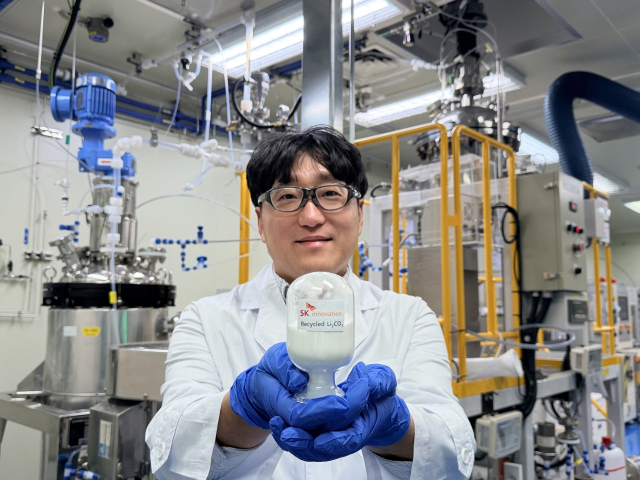
SK Innovation (096770.KS) announced Wednesday that its recycling technology for lithium iron phosphate (LFP) batteries has been published in Separation and Purification Technology, an internationally renowned journal in chemical engineering.
The company developed an eco-friendly process that selectively recovers lithium carbonate (Li₂CO₃) from LFP batteries using only water (H₂O), carbon dioxide (CO₂), and hydrogen peroxide (H₂O₂). Conventional LFP battery recycling processes have faced limitations due to significant environmental burdens from byproduct treatment and wastewater generation, as well as poor economic viability from high processing costs.
The achievement is considered a breakthrough in the LFP recycling sector, which has been criticized for its environmental and economic constraints. SK Innovation's eco-friendly recycling technology is expected to contribute significantly to future battery resource circulation and industry expansion by reducing environmental burdens while efficiently recovering raw materials.
LFP batteries are rapidly gaining market share in the electric vehicle and energy storage system (ESS) sectors. According to the International Energy Agency (IEA), LFP battery market share reached 50% last year, driven by growing demand from China. The technology's advantages—including lower prices, higher safety, and longer lifespan—have accelerated adoption not only in budget and mid-range EVs but also in ESS applications. SK On, a subsidiary of SK Innovation, is preparing to produce pouch-type LFP cells for ESS and EVs in line with this market trend.
As LFP battery demand grows, the capacity to recover and recycle used batteries has emerged as a critical factor determining industrial competitiveness and resource security. The importance of stable lithium recovery and eco-friendly processing technology is increasingly emphasized as LFP battery adoption in ESS expands.
"This achievement surpasses the limitations of existing battery recycling methods and represents crucial technology for driving a sustainable virtuous cycle in the battery market," said Kim Pil-seok, head of SK Innovation's Environmental Science and Technology Institute. "By stably recovering high-purity lithium carbonate, we will mitigate lithium supply risks and expand cooperation with domestic and international battery manufacturing, materials, and recycling companies to contribute to the growth of the industrial ecosystem."