
KAIST Professor Choi Won-ho Wins K-T Rie Award for Plasma Research
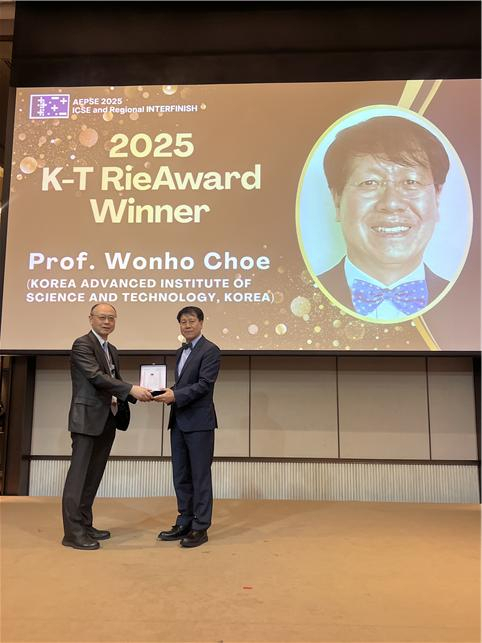
KAIST announced Wednesday that Professor Choi Won-ho has been named the recipient of the K-T Rie Award at AEPSE 2025 (Asian-European Conference on Plasma Surface Engineering), a leading international conference in applied plasma science and engineering.
AEPSE is an international conference held biennially that brings together plasma surface engineering researchers from Asia and Europe to share the latest research findings. The K-T Rie Award, which Choi received, was established in 2015 to honor the achievements of Professor Lee Kyung-jong, a Korean-born plasma surface engineering scholar who worked in Germany. The award is given every two years to international researchers who have made outstanding contributions to the advancement of applied plasma science and engineering.
Choi has gained international recognition for his research on physical and chemical changes occurring at plasma-liquid interfaces. He developed Plasma Imaging Diagnostics technology that enables real-time observation of plasma reactive species generation and energy transfer processes, earning high praise for elucidating key mechanisms of interfacial reactions.
Building on these fundamental achievements, Choi applied low-temperature plasma technology to the medical field and led the founding of Plasmapp, achieving commercialization results including plasma sterilizers and bio-plasma products. He also expanded his research into the space sector, co-founding the Hall thruster development startup Cosmo Bee with his students, based on plasma technology for electric propulsion. This technology recently led to the development of a CubeSat equipped with a plasma Hall thruster, which was launched on Korea's fourth Nuri rocket mission, demonstrating real-world space technology applications.
Additionally, Choi served for 10 years on the Science and Technology Advisory Committee of ITER, the international nuclear fusion experimental reactor located in Cadarache, southern France. His academic leadership in guiding domestic and international plasma research trends was also highly recognized, including his roles as editorial board member for numerous international journals and conference organizing committee chair.
"I am honored to receive the K-T Rie Award. This recognition reaffirms the international competitiveness of Korea's plasma research and is thanks to KAIST's interdisciplinary research environment," Choi said. "I will continue to work harder for the advancement and expanded applications of plasma science."